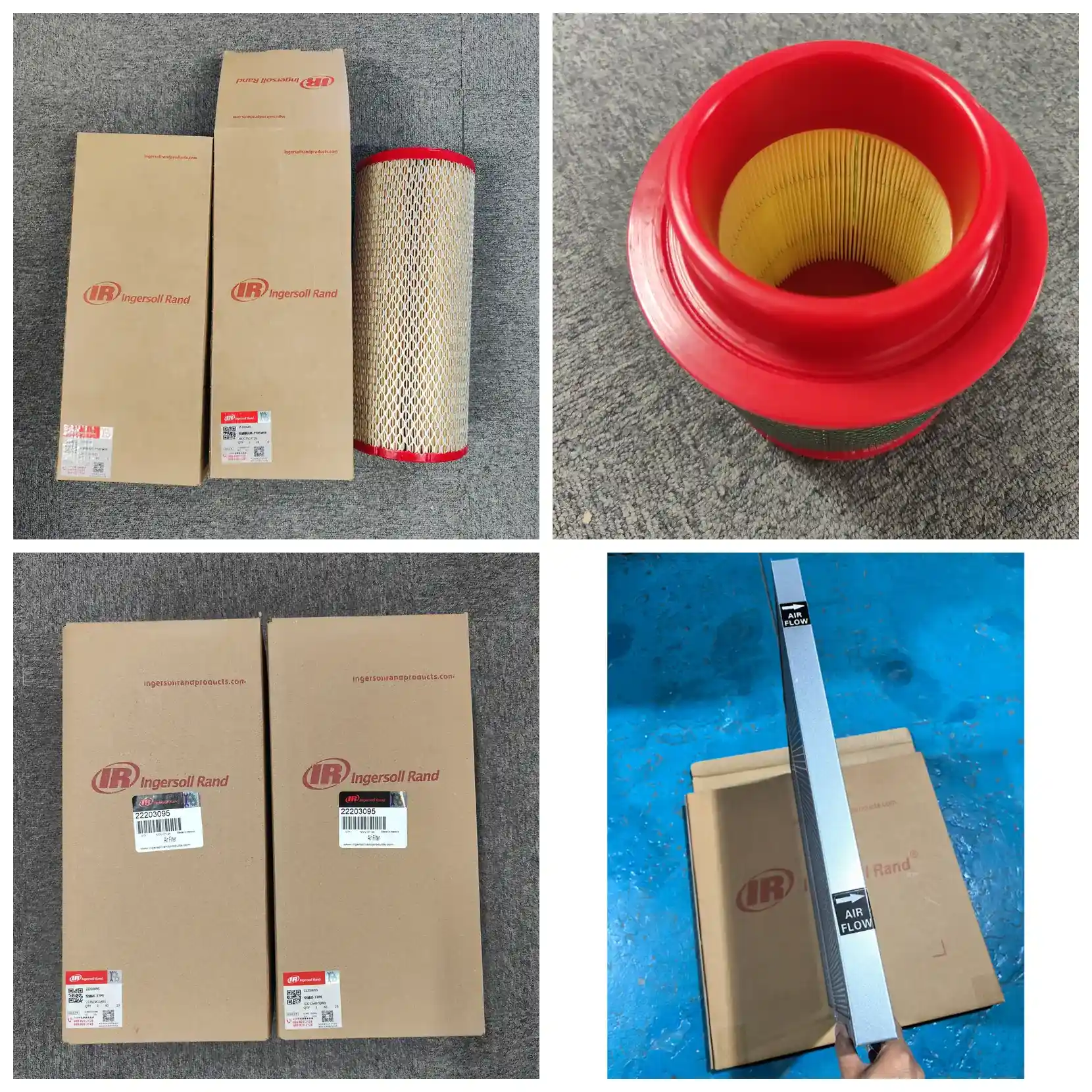
Product
Ingersoll Rand 49164395 Air Filter Element | Donaldson FPG10 RadialSeal
Ingersoll Rand 49164395 air filter element built to Donaldson FPG10 two-stage RadialSeal specification. OD 208 mm, ID 106 mm, length 409 mm, 99.9% filtration efficiency (ISO 5011), 2000-hour service interval. Supplied as the primary element with in-stock export packing for OEM and distributor programs.
- Export packaging & documentation support
- OEM / ODM customization available
- Sample and bulk order workflow
49164395 is the intake air filter element used on Ingersoll Rand screw air compressors equipped with the Donaldson FPG10 air cleaner. It serves as the primary element inside a two-stage RadialSeal filtration system, not a conventional single-stage cartridge.
Why the Two-Stage FPG10 Design Matters
Air first passes through an integrated tangential pre-cleaner. The airstream enters tangentially and spins at high velocity, so centrifugal force throws coarse particles against the housing wall. Roughly 85% of coarse dust is separated before it reaches the main element and is discharged automatically through the Vacuator dust valve at the base of the housing. Only the pre-cleaned air reaches the cellulose main element for fine filtration. In dusty environments this load-sharing structure keeps the primary element on fine-particle duty only, extending service life compared with single-stage cartridges.
Sealing is also different. FPG uses Donaldson RadialSeal technology: a one-piece molded polyurethane end cap forms a radial seal directly against the housing outlet tube, eliminating the glued gasket found on older axial elements. Fewer parts means fewer failure points, and no tools are required for installation or removal.
Key Specifications
- Part number: 49164395
- Specification basis: Donaldson FPG10 (two-stage RadialSeal)
- Role in assembly: primary element
- Dimensions: OD 208 mm × ID 106 mm × length 409 mm
- Net weight: approx. 1.88 kg
- Filtration efficiency: 99.9% (ISO 5011)
- Pre-cleaner efficiency: up to 85% of coarse dust removed
- Rated intake airflow: ≤346 cfm / 9.8 m³/min
- Recommended replacement interval: 2000 hours or 3 months
Performance Data
Filtration rating is 5 μm for the main element, with dust holding capacity of approximately 1200 g. Initial pressure drop is about 0.5–1.0 kPa (50–100 mmH₂O). Filter media is cellulose with a nominal weight of 130 g/m², supported by galvanized steel inner and outer perforated screens. The one-piece polyurethane end cap encapsulates both the media ends and the sealing surface; there is no separate gasket or seal ring. Continuous operating temperature is 83 °C, and relative humidity should not exceed 80% RH without condensation.
Intake restriction directly affects energy consumption. As a theoretical reference at 0.7 MPa discharge pressure and 101.3 kPa atmospheric pressure, each 1 kPa of intake restriction adds roughly 1% to specific power. Moving from a new element at 0 kPa to a heavily loaded element at 6 kPa raises relative energy consumption by approximately 6.3%. This is why the FPG10 housing includes a restriction indicator port: replacement timing should follow actual restriction, not calendar estimates alone.
Installation and Maintenance Notes
FPG maintenance is tool-free and typically takes about 15 minutes:
- Stop the compressor, confirm system pressure is zero, and apply lockout/tagout.
- Release the FPG housing access cover latches — no tools required.
- Pull the old element out by the polyurethane end cap. Note that RadialSeal elements have no gasket to peel off; any residual gasket on the outlet tube indicates a previously mis-installed non-genuine part and must be cleaned away.
- Inspect the Vacuator dust valve at the housing base. It must open and close freely with no caked dust or obstruction. A blocked valve disables the pre-cleaner and shifts the full dust load onto the main element.
- Check the pre-cleaner zone and housing interior for dust bypass tracks. A clean inner wall with no dust trails indicates correct sealing.
- Push the new 49164395 element into the housing until the polyurethane end cap contacts the outlet tube. Do not add any gasket.
- Refit the access cover and latches. Confirm the restriction indicator reads in the green zone and resets correctly.
- Start the compressor, run to operating temperature, and record intake restriction, date, and running hours.
Important: never start the compressor before the element is fully seated. If the RadialSeal end cap is not pushed home, air bypasses directly through the gap between cap and outlet tube, defeating both filtration stages.
Frequently Asked Questions
Is this the same as part 49101637? No. 49101637 is the FPG09 specification, with different dimensions and rated airflow. Check the specification marking on the end cap of the element currently installed: FPG10 means this part, FPG09 means 49101637. The two are not interchangeable.
Why is there no gasket? RadialSeal forms the seal through the molded polyurethane end cap itself. No glued gasket or separate seal ring is needed, which reduces part count and installation error.
Can the element be cleaned and reused? No. It is a dry, disposable element. Do not wash it or blow it out with compressed air, which damages the media structure and creates invisible bypass paths.
How do I confirm fitment? Three options: read the specification marking on the current element end cap; measure the old element to confirm OD 208 mm and length 409 mm; or provide the air cleaner housing model or machine nameplate so we can cross-check against FPG specifications.
Related Service Parts
The FPG10 air cleaner is a complete system. Alongside the primary element, the following components should be checked at each service: the safety element inside the primary, the Vacuator dust valve, the restriction indicator and its tubing, the access cover and latches, the molded housing assembly, and the intake hose and clamps. The FPG09 primary element (part 49101637) belongs to the same series but must not be mixed in stock. Replacing the Vacuator valve and restriction indicator when they fail costs far less than the main element life they protect.